The 1968 quarter value often creates confusion. Some assume it is silver. Others believe age alone makes it rare. A few expect hidden mint mark varieties. The truth is more technical: the coin belongs to the early clad era. Its price depends on grade and other factors, not nostalgia. So, let’s make things clear.
Historical Position: The Early Clad Period
The Washington quarter changed in 1965. Silver disappeared from regular production. A copper core with nickel outer layers replaced 90% silver. By 1968, this new composition was standard.
That matters.
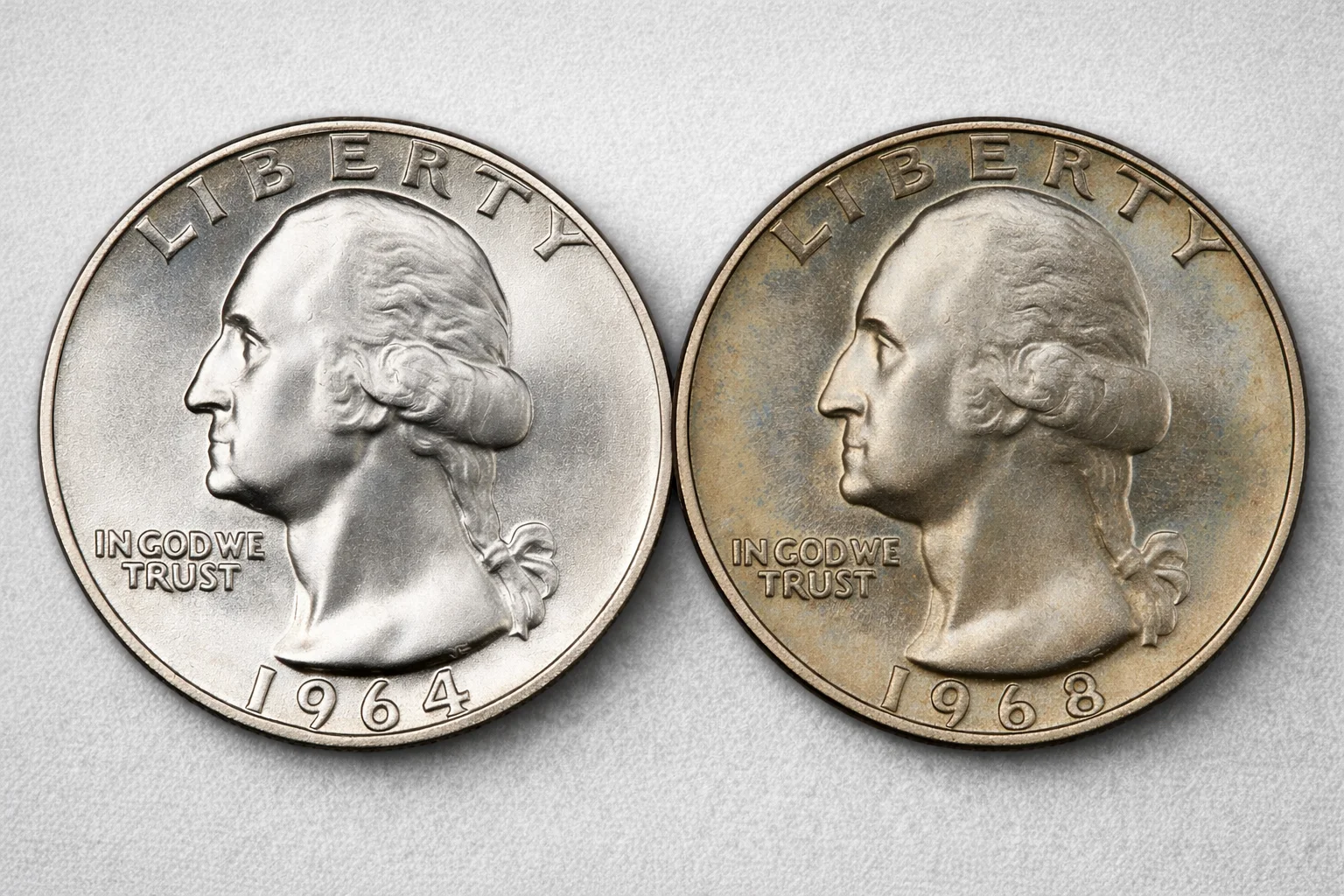
A 1964 quarter contains silver and always carries melt value. A 1968 quarter does not. There is no intrinsic metal floor supporting its price. Value must come from condition, rarity in grade, or recognized varieties.
Production also stabilized by 1968. Mint marks returned after being removed from 1965–1967 issues. Denver struck circulation coins. San Francisco produced proof versions. Philadelphia did not issue circulation quarters that year.
This structure defines the market.
Collector Myths vs Market Facts
Myth #1: “The 1968 Quarter Is Silver”
In reality, it is not. The composition of these quarters is as follows:
| Year | Composition | Silver Content |
| 1964 | 90% Silver | Yes |
| 1968 | Copper-Nickel Clad | No |
The 1968 quarter weighs 5.67 grams and contains a copper core. The outer layers are copper-nickel. No silver is present.
There is no melt premium. A worn 1968 quarter is worth twenty-five cents.
Myth #2: “It’s Old, So It Must Be Rare”
Age does not create scarcity.
The Denver Mint struck roughly 246 million circulation quarters in 1968. San Francisco produced around 3 million proofs. Those are not small numbers.
Large mintage means broad survival. Circulated pieces remain common. Even uncirculated coins appear regularly in original rolls and mint sets.
Rarity must be measured by supply and demand. The 1968-D quarter has a strong supply.
Basic Specifications
| Feature | Detail |
| Year | 1968 |
| Circulation Mint | Denver (D) |
| Proof Mint | San Francisco (S) |
| Composition | Copper-Nickel Clad |
| Weight | 5.67 g |
| Diameter | 24.3 mm |
| Edge | Reeded |
| Circulation Mintage | ~246,000,000 |
| Proof Mintage | ~3,000,000 |
Design remained unchanged from earlier Washington quarters. Obverse shows Washington by John Flanagan. Reverse displays the eagle.
The coin’s metal structure affects grading. Clad surfaces show contact marks easily. That becomes important later.
Myth #3: “No Mint Mark Means It’s Valuable”
This is a common confusion.
In 1968, circulation quarters were struck only in Denver. They carry a “D” mint mark. If a coin appears to lack a mint mark, several explanations exist:
- Heavy wear removed the “D”
- Die fill obscured it
- Damage affected the surface
- Weak strike
Philadelphia did not produce circulation quarters in 1968. There is no regular “no mint mark” circulation variety.
However, certified MS68 examples of 1968-D quarters may be sold between $2,500 and $4,000+. That premium comes from grade rarity, not mint mark absence.
Condition drives that result.
Myth #4: “All 1968 Quarters Are Worth More Than Face Value”
In reality, market data shows otherwise.
Real Market Prices
| Condition | Typical Market Value |
| Circulated | $0.25 |
| AU | $0.25–$0.50 |
| MS63 | $2–$4 |
| MS65 | $5–$10 |
| MS67 | $75–$150 |
| MS68 | $2,500–$4,000+ |
Most examples remain face value. Even lightly uncirculated pieces bring only modest premiums.
The premium begins at higher Mint State levels. At MS67, collectors start competing. At MS68, survival numbers drop sharply. That scarcity creates strong auction results.
The date itself does not create value. Grade does.
Myth #5: “Proof Coins Are Rare by Default”
The 1968-S proof quarter is not rare. Around 3 million were produced. That is a healthy figure.
Proof coins feature mirror fields and frosted devices. They were sold in sets. Many survive in original packaging.
Market levels:
| Grade | Typical Value |
| PR65 | $5–$10 |
| PR67 | $10–$20 |
| PR69 Deep Cameo | $30–$60 |
| PR70 | $150+ |
Deep Cameo contrast brings stronger demand. Perfect PR70 examples carry premiums. Lower grades remain affordable.
Proof status does not guarantee high value. Eye appeal and grade still control price.
Myth #6: “Any 1968 Quarter Error Is Valuable”
Error discussions often inflate expectations. Only certain varieties carry serious premiums.
1968-D Doubled Die Reverse (FS-801)
This is the most recognized variety of date. It shows doubling on reverse lettering. True hub doubling must be visible.
Strong examples can reach several hundred dollars. Certification is essential. Machine doubling does not qualify.
No Mint Mark Specimens
Philadelphia did not issue circulation quarters. Missing mint marks usually result from die fill or wear. These do not command large premiums.
Certified MS68 coins, regardless of variety, can reach $2,500–$4,000+. The value comes from preservation, not mint mark anomalies.
Filled Mint Mark / Filled Letters
A worn die may cause the “D” to appear blob-like. This is common. Premiums are minimal.
Overlapping Rim or Lettering
If the design touches or overlaps the rim due to strike issues, the value depends on the severity. Minor examples bring limited interest. Dramatic off-center strikes bring more attention.
1968-S Proof RPM
Some San Francisco proofs show repunched mint marks. These require verification. Modest premiums apply if clearly defined.
High-value errors share three traits:
- Strong visual evidence
- Third-party attribution
Documented auction history
Without those elements, market demand remains weak.
Clad Era Production Reality
Why High Grades Are Scarce
Clad coins suffer surface damage easily. Several factors reduce survival in top condition:
- High-speed production
- Bulk bag storage
- Contact between coins
- Thin outer layers showing marks
MS63 to MS65 coins are common. Many survive in rolls.
MS67 coins require cleaner surfaces and stronger strike quality. These are less frequent.
MS68 coins are extremely rare in certified populations. The high mintage does not prevent conditional rarity at extreme grades.
Premium begins at the condition level.
Comparing 1968 to 1964 Silver Quarter
The difference is structural.
1964 contains silver. It has melt value. That creates a price floor.
1968 contains no precious metal. Its value depends entirely on collector demand.
Silver issues maintain intrinsic backing. Clad issues depend on grade scarcity.
That difference explains long-term market behavior.
Should You Keep a 1968 Quarter?
The answer depends on the coin.
Keep it if:
- It appears near flawless
- It shows strong strike detail
- It may reach MS67
- It matches a confirmed FS-801 profile
- It is a high-quality Deep Cameo proof
Do not accumulate large quantities of circulated coins expecting appreciation. Bulk supply limits growth.
Building a Washington series set makes sense. Registry collectors seek top examples. Investors seeking metal content should focus elsewhere.
FAQs
- Is the 1968 quarter silver?
No. It is copper-nickel clad. No silver content.
- Why was only Denver used for circulation?
Mint production was centralized. Philadelphia did not strike circulation quarters that year.
- What is the most valuable 1968 quarter?
Certified MS68 examples and strong FS-801 doubled die reverses.
- Are filled mint marks valuable?
Usually not. They result from the die wear.
- Should I grade mine?
Only if it appears nearly flawless or shows a confirmed variety. Grading fees exceed the value of most examples.
- Is the proof version better?
Proofs are higher quality but common. Deep Cameo and high grades bring stronger premiums.
Conclusion
The 1968 quarter belongs to the early clad era. It carries no silver. It was struck in large numbers. Most examples remain worth face value.
Real premiums appear only in high certified grades or recognized varieties such as the FS-801 doubled die reverse.
The market rewards preservation, not age. Condition determines price.
For identification and quick specification checks, tools like Coin ID Scanner can confirm mint mark, composition, and general market range from a photo. The database covers over 187,000 coins with high recognition accuracy. Final value still depends on grade and verification.
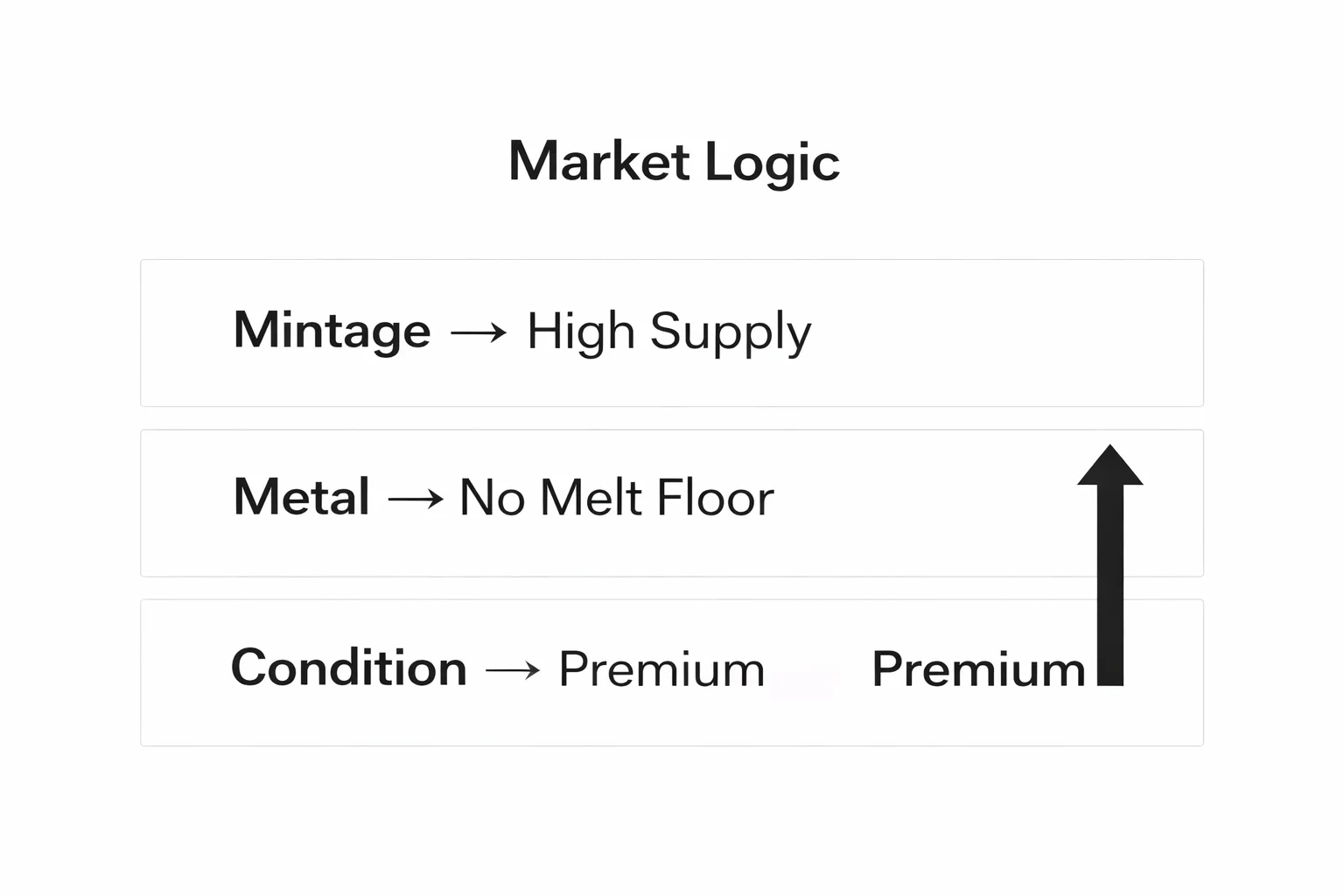
The message is clear: mintage limits rarity; metal limits intrinsic value; condition creates price.